
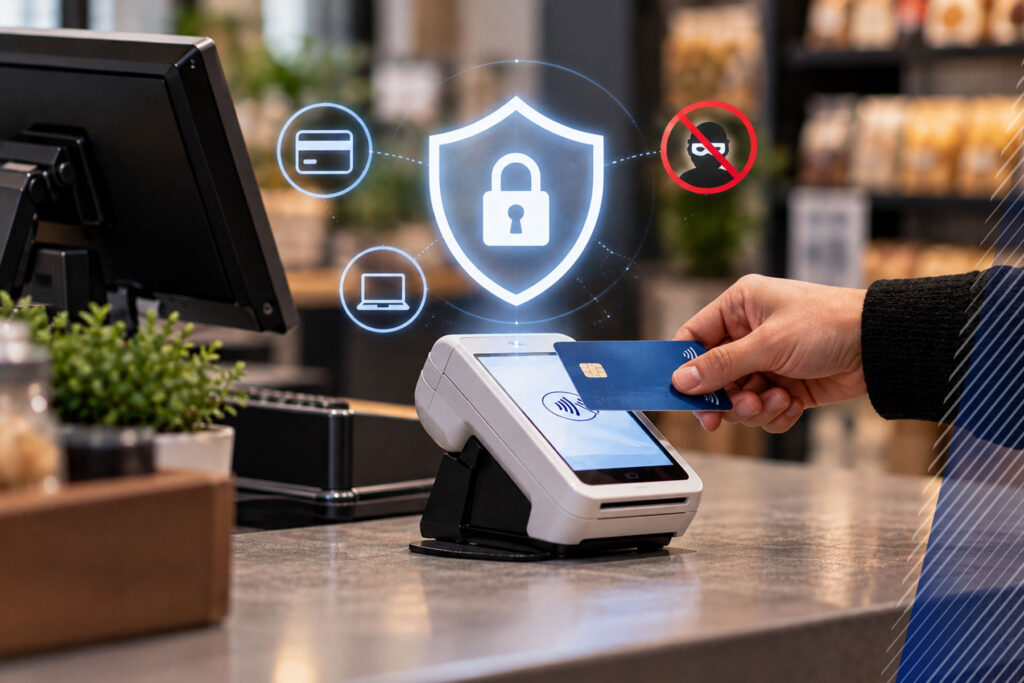
Why the Holidays Are Prime Time for In-Store Payment Fraud
Higher transaction volume means each individual sale gets less attention, and that is exactly what in-store payment fraud depends on. New hires may not know what a tampered terminal or a suspicious return looks like. And the weeks after the holidays bring a wave of returns: the National Retail Federation expected shoppers to send back about 17% of holiday sales in 2025, and retailers estimated that roughly 9% of all returns are fraudulent. For a small merchant, even a handful of bad transactions can wipe out the profit from a strong weekend. That makes prevention worth a few extra minutes of your team’s time.Card Skimmers: The Hidden Side of In-Store Payment Fraud
Skimming is one of the hardest types of in-store payment fraud to catch. A skimmer is a hidden device that captures card data (and sometimes PINs) when a customer pays. Criminals can install one on a card reader or PIN pad in seconds when the counter gets busy. The PCI Security Standards Council calls merchants “the first line of defense” and warns that changes to terminal cables and connections can be difficult to spot.
Skimming is also a major concern for stores that accept SNAP. The USDA Food and Nutrition Service recommends that SNAP retailers inspect their point-of-sale machines and PIN pads multiple times every day. Their guidance includes:
- Pulling up on the top of the terminal and lifting it to check for loose or unfamiliar parts
- Placing identifying marks on your equipment and investigating if a mark is damaged or covered
- Keeping items away from terminals where a hidden camera could be concealed
- Using surveillance cameras to monitor the checkout area
- Confirming that every service visit was scheduled with your equipment provider
If you find a skimmer or signs of tampering, stop using the device immediately, contact local law enforcement, and notify your POS provider. SNAP retailers should also report it to the USDA Office of Inspector General Hotline at (202) 690-1622.
Stolen and Counterfeit Cards
Chip cards made counterfeiting harder, but they did not end in-store payment fraud. A Federal Reserve Bank of Kansas City study found that the lost-or-stolen fraud rate on signature debit networks almost tripled between 2015 and 2021, and that merchants’ fraud losses on those transactions ended up exceeding card issuers’ losses. In other words, fraud has shifted, and merchants are absorbing more of it. Train your team to follow a few simple rules:- Always dip or tap. Chip and contactless transactions are far harder to fake than a magnetic stripe swipe. Be cautious when a card “won’t read” and the customer pushes you to swipe or key in the number.
- Encourage PIN entry when it is offered. A PIN is something a thief with a stolen card usually does not have.
- Watch for red flags. Customers buying several high-value, easy-to-resell items without caring about size or price, trying multiple cards after a decline, or rushing staff are all worth a second look.
- Check ID on large purchases when your store policy and card network rules allow it.
Return and Refund Scams After the Holidays
Return fraud is one of the fastest-growing forms of in-store payment fraud, and it spikes right after the holidays. According to the NRF, the most common schemes retailers reported include overstating the quantity being returned, “empty box” returns where the product is missing or swapped, and decoy returns involving counterfeit items. To protect yourself:- Post a clear, easy-to-read return policy at the register and print it on receipts
- Open every box and inspect the item before issuing a refund
- Refund to the original payment method whenever possible
- Require a receipt or a transaction lookup for returns, and track frequent returners
- Limit who on your staff can approve refunds, especially cash refunds
Gift Card Scams
Gift cards make great last-minute presents, which also makes them a favorite tool for scammers. The Federal Trade Commission notes that victims are often pressured to buy gift cards while a scammer stays on the phone with them, and that criminals may tamper with cards on the rack to steal the balance once they are activated.- Inspect gift card packaging and protective stickers before the sale
- Be alert to customers buying large amounts of gift cards while being directed by someone on the phone
- Politely let at-risk customers know that no real business or government agency will ever ask to be paid in gift cards
- Alert a manager when a purchase feels off
Counterfeit Cash
Not every fraud attempt involves a card. Busy registers are an easy target for counterfeit bills, especially larger denominations. The U.S. Currency Education Program offers free training, downloaded materials, and a mobile app to help businesses learn the security features of U.S. Currency. Keep a quick reference at each register and teach seasonal staff to check the feel of the paper, the security thread, and the watermark on $20, $50, and $100 bills.Chargebacks and Delayed Disputes
Some in-store payment fraud does not show up until weeks later, when a cardholder disputes a charge. The best defense is good records. Keep receipts and transaction details organized, make sure your business name on customer statements is easy to recognize, and respond to dispute notices quickly. Chip and PIN transactions also give you stronger footing than keyed-in sales if a dispute comes up.
How an All-in-One POS Helps Prevent In-Store Payment Fraud
Your checkout equipment is one of your strongest defenses against in-store payment fraud. CHEXIT POS is an all-in-one POS system that supports chip and contactless payments, keeps transaction records organized for easier dispute responses, and accepts EBT alongside credit and debit, so every customer checks out on the same secure device. When your POS is up to date, your team spends less time second-guessing transactions and more time serving customers. If you are still relying on older equipment, the holiday season is a good reason to ask whether an upgrade makes sense. And if you accept SNAP, it is also worth reviewing how your checkout is preparing for newer EBT chip cards.Your Holiday In-Store Payment Fraud Prevention Checklist
- Inspect and lift every terminal and PIN pad several times a day
- Mark your equipment and verify all service visits
- Train seasonal staff on dip or tap first, PIN when offered, and common red flags
- Post your return policy and inspect every returned item
- Check gift card packaging and watch for phone-directed purchases
- Keep a counterfeit currency guide at each register
- Organize receipts and records to respond quickly to chargebacks