
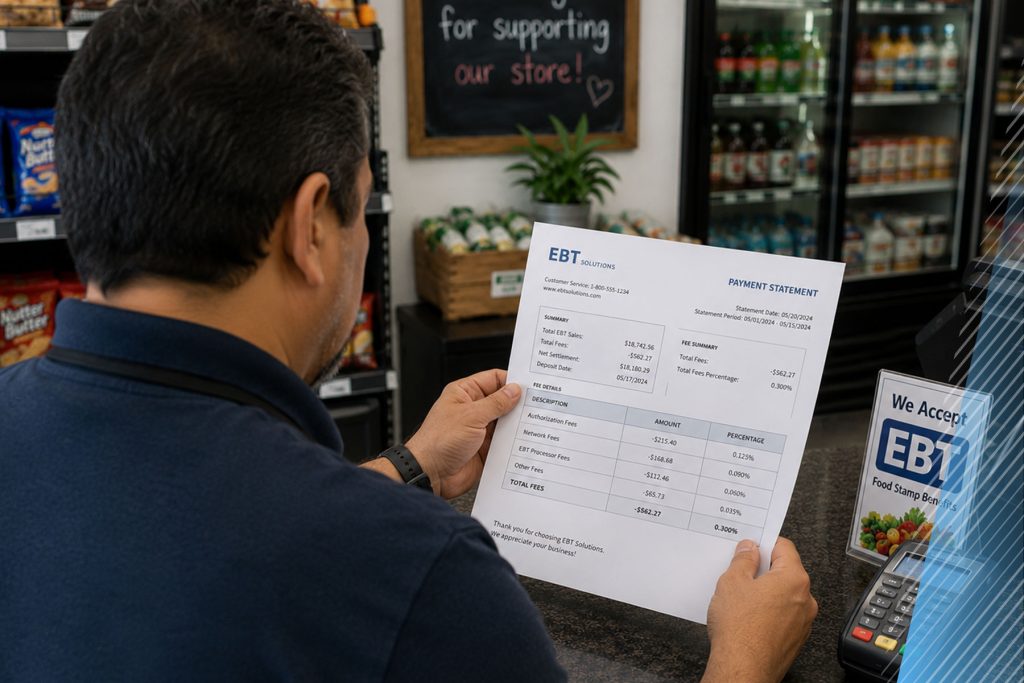
Most merchants set up EBT processing, check the box, and move on. Getting authorized, selecting a terminal, and training staff is already a lot of work. Once it is done, most store owners never go back to look at what they are paying in EBT processing fees month to month. That is where processors quietly profit. EBT processing fees are often buried inside a broader statement, making them easy to overlook, even when the charges are higher than they should be. With SNAP participation at record levels and more transactions running through EBT than ever, the cost of overpaying adds up faster than most merchants realize.
Here are five signs your current EBT processing fees may be costing you more than they should.
Sign 1: You’re Paying Per Transaction
Per-transaction pricing is one of the most common and costly EBT processing fee structures out there. Every time a SNAP customer checks out, a fee gets added to your bill. For low-volume stores, the monthly total might seem manageable. But for any store with steady EBT traffic, per-transaction fees accumulate fast.
The real problem with this model is what it does at scale. The more SNAP customers you serve, the higher your EBT processing fees, not because you are getting better service or faster processing, but simply because your store is busier. You are essentially being penalized for serving a larger share of your community.
This is the core reason flat-rate unlimited processing exists. With a model like goEBT’s unlimited EBT processing, merchants pay one consistent monthly fee regardless of how many transactions run through the terminal. A store processing 500 EBT transactions a month pays the same EBT processing fee as a store processing 100. Growth does not get penalized.
Sign 2: Your EBT Processing Fees Change Month to Month
Pull up the last three months of your processing statements and look at the EBT line. If the number is different every month, that is a sign you are on variable or per-transaction pricing, meaning your EBT processing fees scale directly with your transaction volume.
Unpredictable EBT processing fees make it harder to budget accurately, harder to evaluate your true margins, and harder to know whether you are getting a fair deal. Busy seasons like summer and the holiday months, when SNAP usage typically peaks, end up costing you more at the register, right when you need margins to hold.
Flat-rate pricing eliminates that variability entirely. You know what your EBT processing fees will be before the month starts, which makes it easier to plan, report, and operate without surprises on your statement.
Sign 3: You’re Being Charged PCI Compliance Fees on Your EBT Account
This one catches a lot of merchants off guard. EBT transactions, meaning SNAP benefit payments processed through the government network, are exempt from PCI-DSS compliance requirements. PCI-DSS is the security standard that governs credit and debit card processing. Because EBT runs on a separate government network and carries no interchange fees, those compliance obligations simply do not apply to EBT processing fees.
Despite this, some processors bundle PCI compliance fees into EBT accounts anyway. It may appear as a monthly compliance fee, an annual assessment, or a routine-looking line item, but it is a charge that should not be part of your EBT processing fees at all.
If your statement includes a PCI fee tied to an EBT-only account, it is worth a direct call to your processor to question it. If the fee cannot be removed or explained, that is a clear signal to start comparing your EBT processing fee options elsewhere.
Sign 4: You Had to Call Your Processor to Find Out What You’re Paying
Transparent pricing should not require a phone call, a contract review, or a 20-minute hold. If you have ever had to ask your processor to explain your EBT processing fees, or if the answer you got was vague, complicated, or changed depending on who you spoke with, that lack of clarity is itself a red flag.
Processors with fair, competitive EBT processing fees have no reason to obscure them. When fees are hard to find or understand, it is often because the pricing structure does not hold up well under scrutiny. A trustworthy processor will tell you exactly what your EBT processing fees are, how they are calculated, and what you would pay if your transaction volume changed.
You should be able to find that number on your statement in under a minute. If you cannot, the problem is not the statement. It is the processor.
Sign 5: You Haven’t Switched Processors Since You First Got Authorized
The EBT processing fee landscape has changed significantly over the past several years. Flat-rate unlimited processing, integrated terminals that handle EBT alongside credit, debit, and OTC health benefits, and next-day terminal shipping for authorized retailers are all accessible options now, including for smaller independents that had fewer choices when they first signed up.
If you have been with the same processor since you first received your FNS number, there is a good chance you are on older, less competitive EBT processing fees. Many merchants simply renew out of habit or inertia, assuming that switching would be complicated or time-consuming. In practice, the process is often much simpler than expected, and the savings on EBT processing fees are real.
It costs nothing to compare. If you have not reviewed your EBT processing fees in the last two years, now is a good time to do it.
What to Do If You Recognize These Signs
Start by pulling your most recent processing statement and identifying exactly what you are paying in EBT processing fees. Look for per-transaction charges, monthly compliance fees, and any line items that vary from month to month. Then run the math: multiply your average monthly EBT transaction count by your per-transaction rate and compare that total to what a flat monthly fee would cost your store.
For most stores with consistent EBT volume, the difference in EBT processing fees is significant. And switching processors is simpler than most merchants expect. With the right partner, it is a matter of a new terminal and updated settings, not a full operational overhaul.
goEBT’s unlimited EBT processing gives merchants one flat monthly EBT processing fee, no matter how many SNAP transactions run through their terminal. No per-transaction charges, no PCI fees on EBT accounts, no billing surprises. For stores with an active FNS number, new terminals ship the next business day.
Contact the goEBT team for a free quote and to find out how much you could be saving on EBT processing fees.